Note: this story was originally published on the online magazine shredded.com in 2016. The site has since been taken down.
Note: this story was originally published on the online magazine shredded.com in 2016. The site has since been taken down.
Note: this story was originally published on the online magazine shredded.com in 2016. The site has since been taken down.
Note: this story was originally published on the online magazine shredded.com in 2016. The site has since been taken down.
Note: this story was originally published on the online magazine shredded.com in 2016. The site has since been taken down.

Semiotics and the Meaning of Tattoos
By Rachel Fernandez
 IMG_1721Describe your image. |  IMG_1717 |  IMG_1723Describe your image. |
|---|---|---|
 IMG_1713Describe your image. |  IMG_1744Describe your image. |  IMG_1764Describe your image. |
 IMG_1743 |  IMG_1767Describe your image. |
se·mi·ot·ics
/ˌsemēˈädiks/
noun
-
the study of signs and symbols and their use or interpretation.
Copeland Smith’s tattoo is in a place where her mormon mother won’t be able to see it. She did that on purpose. It’s been half a year since she got inked, and her parents have never seen the design.
sig·ni·fi·er
/ˈsiɡnəˌfī(ə)r/
noun LINGUISTICS
-
a sign's physical form (such as a sound, printed word, or image) as distinct from its meaning.
Simple black line-work of a wardrobe with two pine trees on the doors lies on her left ribs perpetually concealed by her clothes.
Her brother Colin has a similar tattoo on his ankle. The same simple style and line-work, but his is a lamp post adorned with the two pines.
Copeland and Colin got their corresponding tattoos together when Colin was visiting his sister in Chicago. They had been considering potential matching tattoos for a while, but the final decision, design and execution all happened within an hour.
Copeland rushes through her words.
“Spur of the moment, we were like, ‘can you do this?’ and the guy drew [the designs] and then I got it tattooed on my body permanently.”
She laughs to herself.
“I went first of the two of us because I knew if I didn’t, I would chicken out.”

sig·ni·fied
/ˈsiɡnəˌfīd/
noun LINGUISTICS
-
the meaning or idea expressed by a sign, as distinct from the physical form in which it is expressed.
The wardrobe and the lamp post are allusions to The Chronicles of Narnia by C.S. Lewis -- a book series Copeland and Colin’s mother read to them as children. In the series, the wardrobe opens up to the magical world of Narnia which resonated with Copeland as a kid and still bears significance in her adult life.
“I like the idea of it being a portal to another world and sort of like an escape,” she says.
Although the design is nothing but a handful of thick black lines, anyone viewing the tattoo can recognize the object it represents. As an illustrator, Copeland finds this to be a powerful aspect of the image.
“I think a picture should be able to tell a story without words. I like a visual that can speak for itself, and people can mostly guess what it is even though it’s really simple line work,” she says.
The image rarely sees the sun, but Copeland is always aware of the meaningful piece of permanent art right above her lungs.
i·con
/ˈīˌkän/
noun LINGUISTICS
-
a sign whose form directly reflects the thing it signifies. The signifier has a physical resemblance to the signified.


Late on a Wednesday night at the beginning of March, Erin Grote finally begins to wind down from her long day of classes at Columbia College Chicago. Despite the fatigue she must be feeling, her bold red lipstick frames an unbroken smile. She enters with a bag of cheese and offers to make me a quesadilla and effortlessly laughs when I enthusiastically accept (partially compromising my journalistic integrity).
It’s below freezing outside of the Logan Square garden unit, but Grote wears a black spaghetti-strap shirt that displays a small sample of her collection of tattoos. One of the most predominant images on her visible skin is large watercolor screech owl on the inside of her right arm. The nocturnal bird is surrounded by yellow ginkgo leaves that give it a place to rest.
The specific icon of the owl was lifted straight from the pages of a birdwatching book given to Grote by her grandma. The two of them would birdwatch together when they were younger. Grote also volunteered at an outdoor education center where she handled and took care of screech owls. The bird has been a positive motif throughout her life.
Grote has struggled with depression and anxiety since she was in junior high, and her freshman year of college, Grote attempted suicide.
“A huge thing about depression is that you get mad tunnel vision, and you can’t think of anything else. It’s just, ‘ending my life is the only way out of this misery,’” she explains.
After a week-long stay in a hospital following Grote's suicide attempt, she traveled back to her home in Ohio where a ginkgo tree she planted when she was about eight years old sits outside of her childhood bedroom window. Ginkgo trees are her favorite. When she arrived, the leaves on the tree were all still in tact but only hanging by a thread.
“What I love most about ginkgo trees is that the leaves fall all at once," says Grote. "When I went home the leaves hadn't fallen yet and I was like, ‘oh, I’m really glad that I’m around so I can witness that.”
“[That weekend] when I was laying in bed, I heard screech owls, and I was just overwhelmed with [the] beauty that was in my life and I never realized it.”
Her tone and the way that she speaks picks up and she makes broad arm gestures that look like the onset of a hug.
“I thought, ‘wow, if I had ended my life and I was successful, I would have never heard a screech owl again; I would have never been able to see the leaves fall again.”
She indicates to the image on her bicep and gains a sense of concentration that she didn’t have before.
“This tattoo is a really good reminder that there’s so much beauty out there.”
Grote also believes that new meanings and significance can be added to a tattoo at any point.
The semester following her suicide attempt, Grote took a humanities course called Exploring the Goddess where she learned about the history and traditions connected to goddesses worshiped throughout time. In the class, she found herself identifying closely with Athena -- the Greek goddess of wisdom, craft and war who is often represented by an owl. Unintentionally, she added another layer of relevance to the elegant icon on her arm.
“It’s not only a reminder of beauty, it’s also a reminder to stay strong.”
She begins to give herself a pep talk.
“You have Athena on your side! Go forward! Show ‘em who’s boss, girl!”
I feel inspired by her enthusiasm and admire her positivity.
Grote also offers up the dual meaning behind the sun tattoo on her middle finger and the moon tattoo on her ring finger.
When she would get panic attacks as a kid, she’d calm down by playing “Here Comes the Sun” on her guitar, and she would always focus on her middle finger as she played -- hence the sun on her middle finger.
She’s also interested in astronomy and the fact that she was born on a night with a crescent moon -- hence the moon on her ring finger.
“That’s the heavy meaning behind my finger tattoos, but a friend pointed out to me that I’m a night person, so it’s like I’m married to the night and f**k the day,” she says with conviction
When asked if she thought she might ever regret her tattoos, Grote feels confident that she’ll always view the art on her body in a positive light. The permanence of the ink on her arm is more of a benefit than a drawback.
“That’s the cool thing about tattoos!” Her eyes light up. “I love the idea of being able to capture this moment or this feeling, and it’s going to be on you forever.”
She fantasizes about getting an “experience tattoo” and romanticizes fleeting time.
“I’m all about capturing a moment and holding onto that moment because I think, in the end, moments are all we’ve got.”
in·dex
/ˈinˌdeks/
noun LINGUISTICS
-
a signifier that shows evidence of what’s being represented.
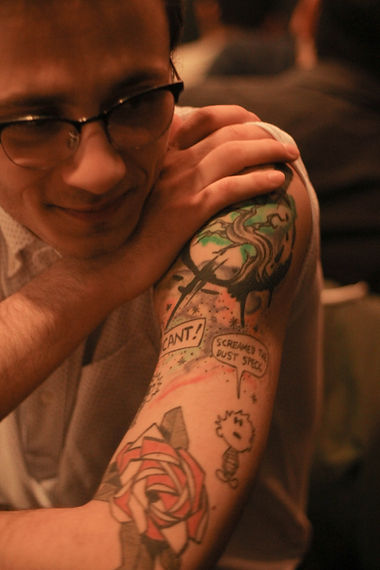

At a house party on a hot summer night after a fair amount of drinks, Tony Fragale’s friend Jack McCoy asks him for a favor: McCoy wants a tattoo. The request seems odd and leaves other partygoers a bit uncomfortable, but Fragale willingly pulls out a cheap tattoo machine and a small vial of black ink. Guests leave the room.
Fragale asks McCoy what design he wants engraved on his body forever.
McCoy gives him free rein.
The two very drunk friends share a mutual feeling of adrenaline and terror.
It was McCoy’s first time getting a tattoo.
It was Fragale’s first time giving a tattoo.
The needle repeatedly strikes McCoy’s shoulder as his bare skin turns crimson and begins to swell.
Fragale doesn’t know it at the time, but the wattage on his machine is turned up much higher than it should be for the design he’s doing.
McCoy swallows his pain to the same place that already holds a pack of beer from earlier in the evening.
After he’s finished, heat radiates from the fresh tattoo and broken skin and Fragale steps back to drunkenly admire a crooked smiley face smoking a cigarette that he permanently etched onto his friend’s body.
They laugh together.
Although the design itself holds little significance, the tattoo tells a story that many onlookers may not be able to see.
“It was great to be a subject of experimentation,” says McCoy. “I don’t mind it, still, which is good, seven months later.”
Fragale is what they refer to in the tattoo industry as a “scratcher,” or a tattoo artist without any professional training. He learned the very basics of the trade from a working artist, but picked up most of the skill on his own through observation, trial and error. Lots of error.
He recounts a time when he drunkenly gave another friend a triangle tattoo on her ankle.
“The thing about tattooing people is that it’s point A to point B. There’s no stopping in the middle,” says Fragale. “You’re not sketching. It’s a permanent f***ing line, so the triangle was all wiggly and s**t. It looks like utter s**t. It’s a good story because she tells me she doesn’t regret it.”
The meaning behind tattoos is the last thing on Fragale’s mind. His upper left arm is mostly covered in various disjointed designs. The rose above his elbow he only got because he thought it looked cool. He clearly won’t be doing any professional tattoo work, but he doesn’t tend to second guess the ones he doles out to his friends.
“I keep to my friends about it. It normally happens if everyone is drunk and someone wants a tattoo and I’m drunk enough to oblige, yeah I’ll do it,” Fragale says. He shrugs and smiles to himself. “My friend Bowie wanted the word ‘neat’ written on his ankle the other night, so I just did it. If he wants it…”
His voice trails off as if giving out tattoos was as casual as lending his friends a dollar -- and to him, it is.
The first time Fragale used his tattoo machine, his body was the canvas. He was scared, but he eventually brought the needle to his skin and marked up his thigh with small lines: a smiley face, a box and a heart that all “hurt like a b**ch.”
“I regret it completely, but it’s a cool story I guess,” Fragale says. “I’ll chalk it up to boyish exuberance.”
Fragale’s unique experiences with tattooing renders him to dismiss almost any significance behind tattoos whether it be from the design or the story.
“It doesn’t f***ing matter in my opinion. I have lines on my thigh that are going to remind me of how stupid I was at 19 years old, and honestly I don’t give a s**t.”
A nebulous Calvin and Hobbs tattoo lies on Fragale’s arm under the short sleve of his button-up shirt. Calvin is screaming to his inner bicep with a speech bubble surrounding block letters spelling out “I’M SIGNIFICANT!”
sym·bol
/ˈsimbəl/
noun LINGUISTICS
-
a signifier that has no resemblance to the signified. The relationship between the the signifier and signified must be learned through cultural context.

The Chicago Tattoo & Body Piercing Co. sits just under two blocks from the Belmont Red Line stop in Chicago. A sign with an intricate, colorful dragon and the name of their shop juts out from the side of the tattoo parlor.
On the inside, three leather couches sit on the black and white checkered floor. A wooden chest filled with paperbacks sits next to the couch farthest from the door. The box has a sign that reads, “Yes! Free books Take some.”
Framed paintings of tattoo flash designs drawn by the five tattoo artists working in the shop line the walls. Each frame of unique designs captures the attention of the customers in the shop. This Friday night in February is busy with young people wearing ripped jeans and warm jackets scuffing their combat boots across the monochrome tile floor -- some to brave their first tattoo, others adding to their collection. Customers admire the art on the walls as they wait to get inked and cycle in and out of the artist’s chairs.

“It’s kind of a weird exchange because when someone comes in I’m altering their path from now on, and they’re just like a stepping stone in mine,” says tattoo artist James Travis. “I see so many people every day every week. I’ve done an uncountable number of tattoos, and I don’t remember anybody’s faces.”

Travis tattoos in a station in the front left corner of the shop. His space is kept organized but slightly crowded with his own drawings and supplies.
A somewhat worn leather chair faces his counter. Vials of ink and bottles of cleaning solutions sit in a neat row. Loose leaves of paper with his own drawings are settled around and underneath.
His designs are inspired by Puritan-era gravestone images, Appalachian folk art and folklore stories. He displays paintings of haunting willow trees, dark flowers and sinister-looking cranes. His Instagram account is colored with shades of grey, black, red and gold with pictures of his art on paper and on skin.
Travis tattoos his own flash and almost all custom drawings, but his better judgment keeps him from tattooing certain designs.
“I don’t tattoo white supremacist stuff,” says Travis. “I’ll pretty much do anything else, but I’ve got that one pretty strong conviction.”
When Travis turns his head, a swastika with a big red slash through it peeks out from under his black beanie behind his left ear.
“It’s definitely started some fights. You’d be surprised at how many people in the last 10 years that I’ve been doing this have asked for white supremacist stuff.”
White supremacy designs tend to manifest in the form of symbols including swastikas and certain styles of crosses. Cultural context and history plagued the designs and branded them as exceptionally heinous. Travis recounts a time he rejected inscribing one of these hate symbols.
“A guy just got out of jail and he brought me a really really sh***y drawing of an octopus that he wanted me to put on his arm, and the octopus had a swastika on its forehead.”
The man tried to convince Travis the symbol was not a really swastika and that it was just a small part of a big tattoo.
“I told him, ‘yeah, I know. I’m not going to do the entire tattoo,’” Travis said, frustrated. “‘Like, I’m just not going to deal with you.’”
White supremacy symbols have a hateful history corrupting their meaning, but Travis still understands his role as a tattoo artist and advising his customers.
“If [the tattoo] is a bad idea, I’m going to be upfront with you,” says Travis. “I’ll normally still do it. If it’s something within my skillset, I’m totally fine to do it.”
At a tattoo convention in Murfeesboro, Tennessee, Travis once tattooed a trash can with a vagina on the front and the words “cum dumpster” above it on a woman’s inner thigh. He didn’t think that design was a particularly good idea, but icon didn’t carry as much weight as the hate behind a swastika, so he complied.
“I’m not here to judge for content,” Travis says. “I’m just here to provide you with a service and guide you through that.”
There’s a dissonance between the spontaneity of a moment and the permanence of a tattoo, but the two can often be coupled together when a customer walks into a tattoo shop.
“It’s like a fixed point in time after you get it, so whatever you’re feeling whenever you’re getting [the tattoo], or whatever led you to come into the tattoo shop to get it, you’re going to be able to see the tattoo and always connect it with that,” says Travis.
Looking at the meaning of a tattoo by virtue of the experience or the moment in time is a precisely different approach than getting a particular design that carries significance, but Travis sees an intersection between the two.
“I’ve noticed that what you’re aesthetically attracted to, even if you don’t know why, eventually you’ll kinda find out the symbolism,” he says. “[Sooner or later], you’ll be like ‘oh! That’s why I’m attracted to that! Because that’s pertinent to my life right now.’”
Travis is no stranger to the needle himself. Various images and designs cover almost every visible area of his body. He says that each of his own tattoos vary in significance. The ones most important to him are a portrait of his grandparents, a straight-edge tattoo symbolizing that he hasn’t been under the influence of drugs in 14 years and the designs he has related to books by H. P. Lovecraft, his favorite author.
Other images on his body may not carry the same weight, but each tattoo has a story.
“I just think that really, if you’re getting tattooed it should be because you want to get tattooed regardless of the reason,” says Travis. “Don’t worry about the reason so much. The reason is either just because you want to do it or the reason is because you feel like marking this period in time for something or the reason might be apparent later.”
His gaze falls on a vague point on the wall.
“Just live in the moment and do it. It’s undeniable history.”